Blog
Vejledninger
8 best AI visibility tracking tools explained and compared 2026
Search behavior is shifting faster than most marketing teams are ready for. AI-powered answer engines are no longer supplementing traditional search, they are actively reshaping how users discover brands.

Vasilij Brandt
Founder of KIME

Search behavior is shifting faster than most marketing teams are ready for. AI-powered answer engines are no longer supplementing traditional search, they are actively reshaping how users discover brands. When a user types a question into ChatGPT, Perplexity, or Google's AI Overview, they receive a synthesized answer drawn from multiple sources. Your webpage ranking may never be seen. What matters now is whether your brand is the source being cited.
AI visibility measures how frequently, and in what context, your brand appears inside AI-generated answers. The objective is no longer to rank a webpage. It is to become a trusted, citable source in large language model (LLM) outputs. That means positioning your content as authoritative and reliable so it is consistently referenced, not just indexed.
To understand what actually moves the needle in this category, we reviewed eight leading AI visibility platforms and evaluated their core capabilities across the features that matter most.
What should be considered an AI visibility tool?
There is still no single industry definition. But from our analysis, the platforms that deliver genuine value share a consistent set of capabilities, grouped into the following core segments.
AI Overview appearance tracking
These tools monitor AI-generated summaries within search engines, including Google's AI Overviews and similar answer-based interfaces. They identify whether and how your brand or URLs appear in AI-generated search results.
LLM answer presence tracking
Advanced platforms execute structured queries across major LLMs, including Perplexity, ChatGPT, Claude, Gemini, and others, and log how often your brand is mentioned. This includes visibility within conversational AI interfaces and multi-step responses.
AI brand mention monitoring
These tools detect brand mentions within AI-generated outputs and provide contextual insights, including sentiment analysis and citation source tracking.
AI search ranking and URL detection
These tools evaluate how your pages and prompts perform within AI-generated results. They identify which of your URLs are being cited, how frequently they appear, their position within responses, and generate an AI ranking or visibility score.
Content optimization (GEO / AEO) tools
The strongest AI visibility platforms also analyse your content against the requirements of AI search and surface gaps. They can audit how AI-ready your website is, recommend new topics or prompts to target, and offer content optimization features such as rewriting pages or generating structured data.
Additional features to consider
Beyond the core segments, the following capabilities are worth evaluating when choosing a platform.
Competitive AI benchmarking, so you can track where competitors are being cited and identify the visibility gaps where they hold an advantage.
Evidence logs and screenshots, valuable for auditing, client reporting, and validating performance over time.
API access and data export, so your team can integrate AI visibility data into dashboards, internal analytics systems, or reports.
AI Visibility Tracking Tools: Comparison Table
Tool | Key Focus / Unique Angle | AI Platforms | Starting Price |
End-to-end AI visibility benchmarking and GEO optimization, action center, prompt volume estimator | ChatGPT, Perplexity, AI-Mode, Gemini, Claude, Grok, Deepseek, Meta AI, Microsoft Copilot, Google AIO | €149/mo (25 prompts, 5 seats) | |
Peec AI | Clean UX, multi-engine tracking | ChatGPT, Google AIO, Perplexity, Claude, Gemini, Copilot | €89/mo (25 prompts) |
Profound AI | Enterprise-grade tracking and CDN integration | ChatGPT, Perplexity, Google AIO, Copilot | $99/mo (50 prompts, ChatGPT only) |
Ahrefs Brand Radar | Brand-level AI index and share of voice | ChatGPT, Google AIO, Claude, Gemini | $199/mo (Per index) |
Semrush | Content optimization, topic and keyword analysis, competitor monitoring | ChatGPT, Claude, Perplexity, Google AIO | $199/mo (50 prompts, 1 user) |
SE Visible | Strategic AI brand visibility overview | ChatGPT, Google AIO, AI Mode, Gemini, Perplexity | $99/mo (150 prompts, 3 brands) |
Scrunch AI | Prompt-level segmentation and deep analytics | ChatGPT, Claude, Perplexity, Gemini, Google AIO/Mode, Meta AI | $250/mo (125 prompts, 5 users) |
Otterly AI | Deep GEO audits (25+ technical factors) | ChatGPT, Perplexity, Google AIO/Mode, Copilot, Gemini | $29/mo (15 prompts) |
1. KIME.ai
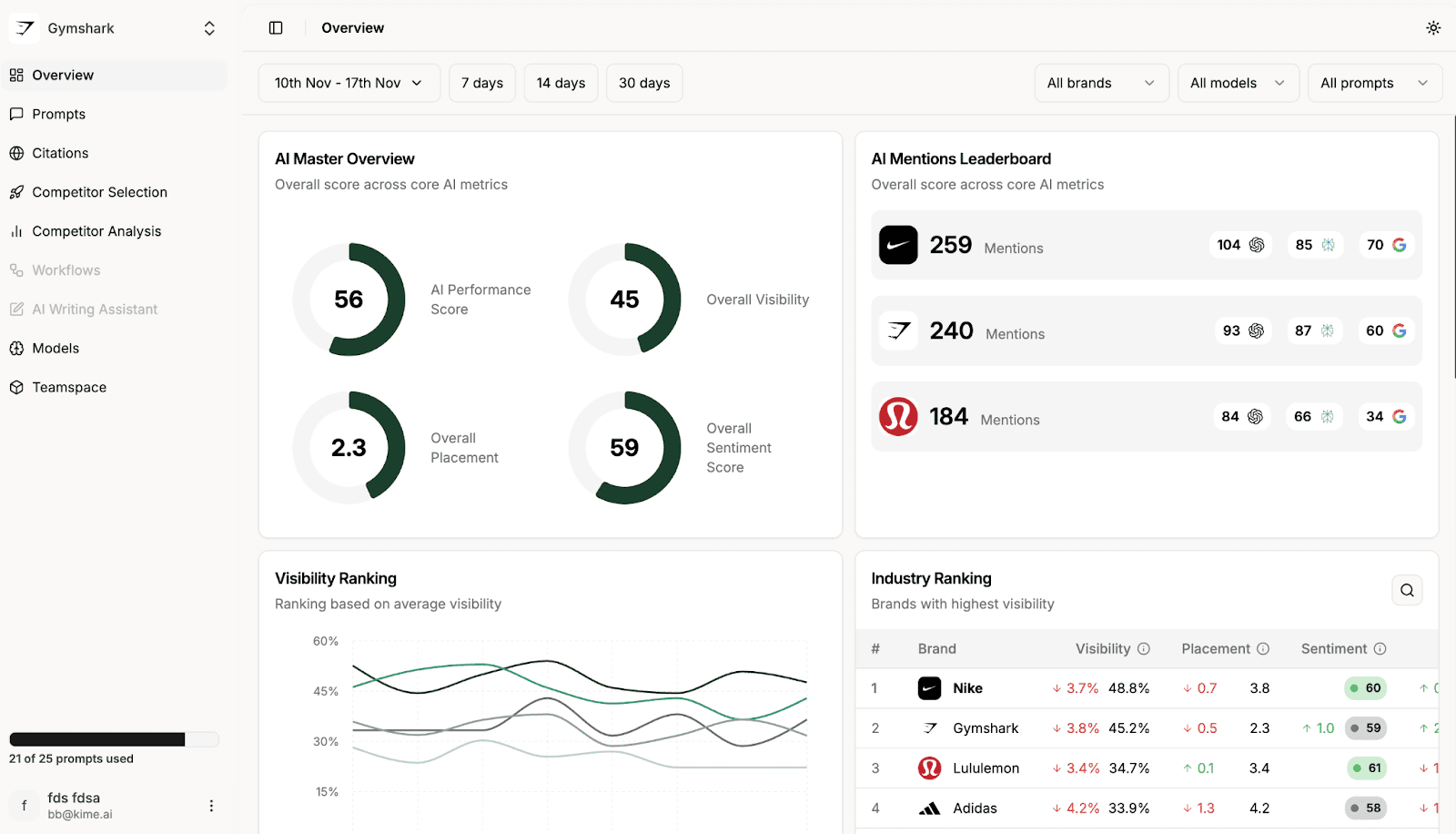
KIME is purpose-built for AI visibility. Unlike platforms that bolt on AI tracking as a secondary feature, KIME was designed from the ground up to help brands understand, measure, and improve how they appear across the major AI answer engines, including ChatGPT, Perplexity, Google AI Overviews, Gemini, Claude, and DeepSeek.
The platform combines ease of use with precision data. Dashboards surface visibility scores, share-of-voice metrics, competitor benchmarking, and citation source analysis without requiring technical expertise to interpret. For teams running GEO programs at scale, KIME's AI perception tool and Action Center tools close the loop between tracking and action.
What we found most valuable
Wide LLM coverage: KIME tracks your brand across all major AI platforms, including ChatGPT, Perplexity, AI-Mode, Gemini, Claude, and DeepSeek, giving you a complete picture of where you stand.
Competitive intelligence: Tracks competitor mentions and sentiment across AI search results, providing clear benchmarking data. Compare your AI visibility with key competitors to surface the gaps that matter and act on them.
Clear metrics: Visibility scores and share-of-voice data are presented in dashboards designed for fast decision-making, not data archaeology.
GEO-ready by design: KIME is one of the few platforms built specifically for AI search and LLM citation tracking, not adapted from traditional SEO tools.
Multi-seat access: Even the entry-level plan supports multiple team members, making it a practical choice for agency and in-house teams alike.
Action Center: AI produced optimization tasks. Like having an AI CMO that tells you exactly what to optimize, how to do it, and how important it is for you to get higher visibility.
Prompt volume estimator: Estimated volume of search traffic for each individual prompt intent.
Sentiment analysis: Track whether AI-generated mentions are positive, negative, or neutral, with daily updates to monitor changes.
Best for
Agency owners, CMOs, and marketing leaders who need a single platform for AI visibility and GEO performance.
Large enterprises seeking to benchmark against competitors across multiple LLM ecosystems.
Marketers who want to both generate AI-optimized content and track its performance in one place.
Pros
Comprehensive LLM coverage across all major AI platforms.
Competitive benchmarking built into the core product.
Real-time data updates, so you are never working from stale snapshots.
Strong early adoption among Nordic enterprise brands.
Cons
For brands with no existing AI mentions, competitive gap analysis has limited initial data to work from.
More feature-rich than some teams need in the early exploration phase.
Pricing
Lite: €149/mo (25 custom prompts, 5 seats, daily prompt frequency, competitor analysis dashboard, AI analytics suite).
Pro: €399/mo (100 unique prompts, 10 seats, daily prompt frequency, full analytics suite).
Free trial available.
2. Peec AI
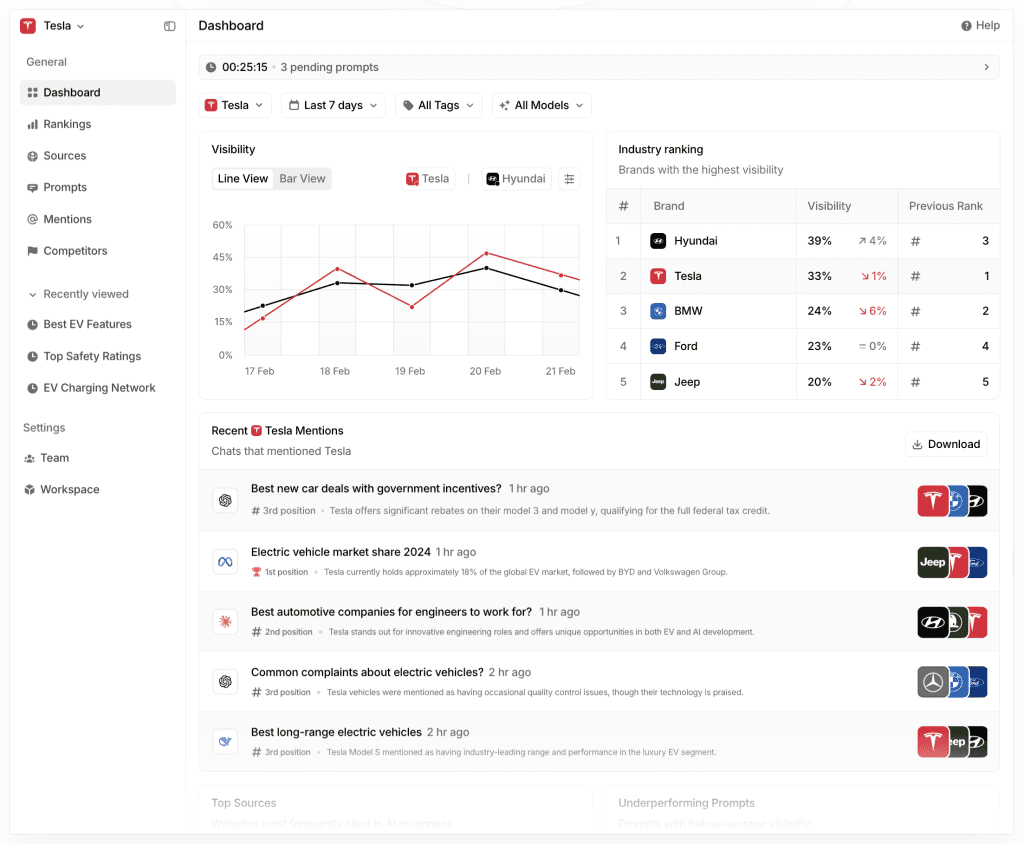
Peec AI is an AI visibility platform that monitors your brand's presence across all major AI answer engines. Setup takes under five minutes, the dashboard is clean and intuitive, and live onboarding sessions help teams get started quickly. The platform is designed to show how and why your brand is mentioned in AI results, with a focus on visibility and sentiment across multiple LLMs.
What we found most valuable
User-friendly interface and onboarding: Peec is easy to navigate from day one, with suggested prompts and guided sessions to help teams move fast without a technical setup process.
Multi-engine tracking: Supports ChatGPT, Google AIO, Perplexity, Claude, Gemini, and Copilot.
Integrated sentiment analysis: Measures positive and negative mentions to give you a clearer picture of how your brand is being framed in AI-generated answers.
Best for
Small to mid-sized marketing teams, particularly B2B and SaaS, that prefer a clean and intuitive dashboard.
Brands with strong existing SEO performance looking to extend that into AI.
Teams focused on sentiment analysis and share-of-voice tracking.
Pros
Quick and easy setup, typically under three minutes.
Sentiment monitoring included in the mid-tier plan, a feature not commonly offered at this price point.
Starter plan supports unlimited users, making it a strong choice for agencies or distributed teams.
Cons
Primarily a data tracking platform. It surfaces trends but does not provide step-by-step optimization guidance or content audits.
Does not estimate website traffic generated by AI mentions.
Sentiment scores are numeric only, without sample responses or optimization suggestions.
Pricing
Starter: €89/mo (25 prompts, 3 countries, ChatGPT/Perplexity/AIO tracking, unlimited seats).
Pro: €199/mo (100 prompts, 5 countries).
Enterprise: €499/mo (300+ prompts).
3. Profound AI
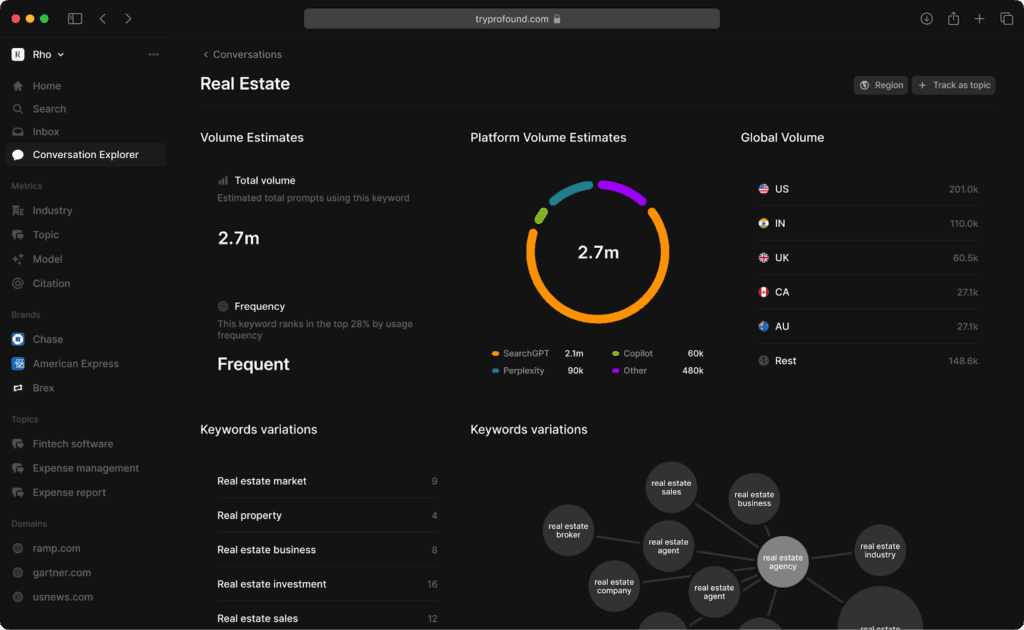
Profound AI is a high-end AI search visibility platform built for enterprise needs. Venture-funded and widely used by Fortune 100 companies, it stands out by monitoring actual AI engine interfaces rather than simulations. The platform tracks your brand across a broad range of AI-generated answers and delivers in-depth analytics tailored for large-scale websites.
What we found most valuable
Sentiment and context monitoring: Continuously tracks brand mentions, highlighting whether they are positive or negative, and displays them in detailed, actionable dashboards.
CDN traffic integration: Connects with Cloudflare and Akamai to correlate AI-driven activity with real user site visits.
Prompt insights: Identifies the types of questions being asked in AI engines, helping teams prioritise high-impact queries.
Competitive intelligence: Tracks competitor mentions and sentiment across AI search results, providing clear benchmarking data.
Best for
Large enterprises and retailers with robust web and CDN infrastructures.
Content teams with dedicated resources who can act on data-driven insights.
Organisations requiring SOC2/SSO compliance, role-based access, and enterprise-level API integrations.
Pros
Comprehensive platform with enterprise-grade features.
Analytics are based on actual AI sessions and CDN traffic logs, not simulations.
Includes Workflows for content creation and optimization with pre-built documents and API integrations.
Cons
Cannot manage multiple companies from a single account.
Limited ability to customise prompts or competitor tracking in granular detail.
Extensive out-of-the-box insights but fewer options for hands-on, DIY adjustments.
Pricing
Starter: $99/mo (50 prompts, ChatGPT only).
Growth: $399/mo (100 prompts, ChatGPT, Perplexity, Google AIO).
Enterprise: Custom pricing.
4. Ahrefs Brand Radar
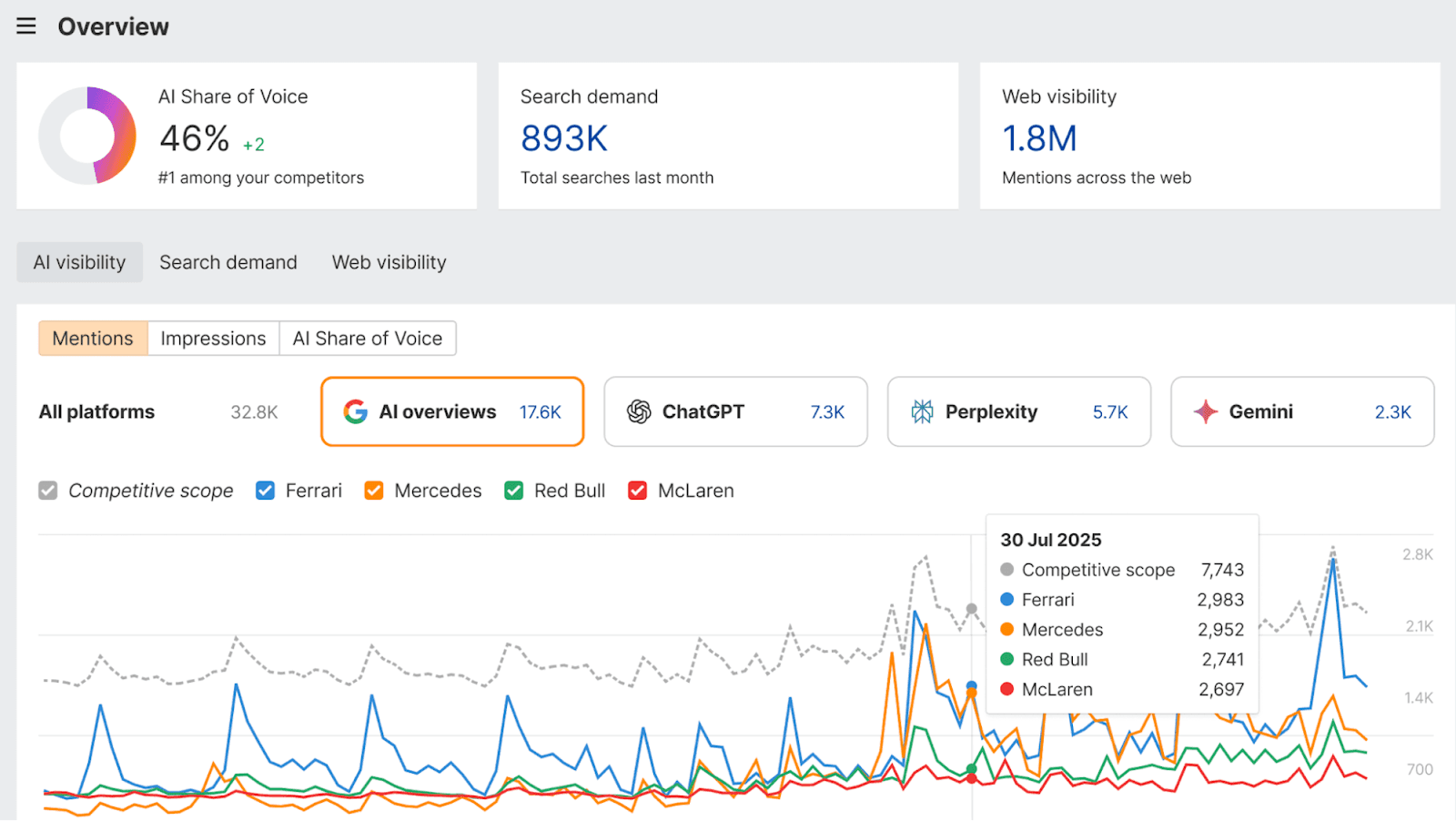
Ahrefs Brand Radar is an AI visibility dashboard built into the Ahrefs platform. It monitors a wide range of AI queries to identify when and how your brand is mentioned in LLM-generated answers. Users praise its rapid growth and robust capabilities, though many note there is still room for improvement on content guidance.
What we found most valuable
Extensive AI index: Brand Radar scans multiple prompt indexes, including ChatGPT, Google AIO, Claude, and Gemini, processing billions of queries automatically.
AI share of voice and gap analysis: Shows the percentage of AI answers featuring your brand compared to competitors, and highlights unbranded queries where your content appears.
Citation tracking: Identifies which URLs are referenced by AI and uncovers new prompts to target for increased citations.
Multi-channel monitoring: In addition to AI answers, Brand Radar tracks metrics from platforms like Reddit and YouTube, giving a fuller picture of brand visibility.
Best for
Companies already using Ahrefs who want AI tracking built into their existing workflow.
Teams focused on brand-level AI visibility metrics at scale.
Marketers wanting to understand AI search results without manually configuring prompts.
Pros
Provides instant AI tracking from the moment you set up.
Handles very large query volumes across multiple AI engines.
Flexible filters allow the creation of custom visibility scenarios.
Cons
Does not offer content recommendations or optimization guidance.
Requires an Ahrefs account, even though Brand Radar itself is included at no extra cost.
Extensive data output but lacks automated audits or step-by-step action plans.
Pricing
Brand Radar is included in any Ahrefs account. The Lite plan starts at $129/mo.
5. Semrush
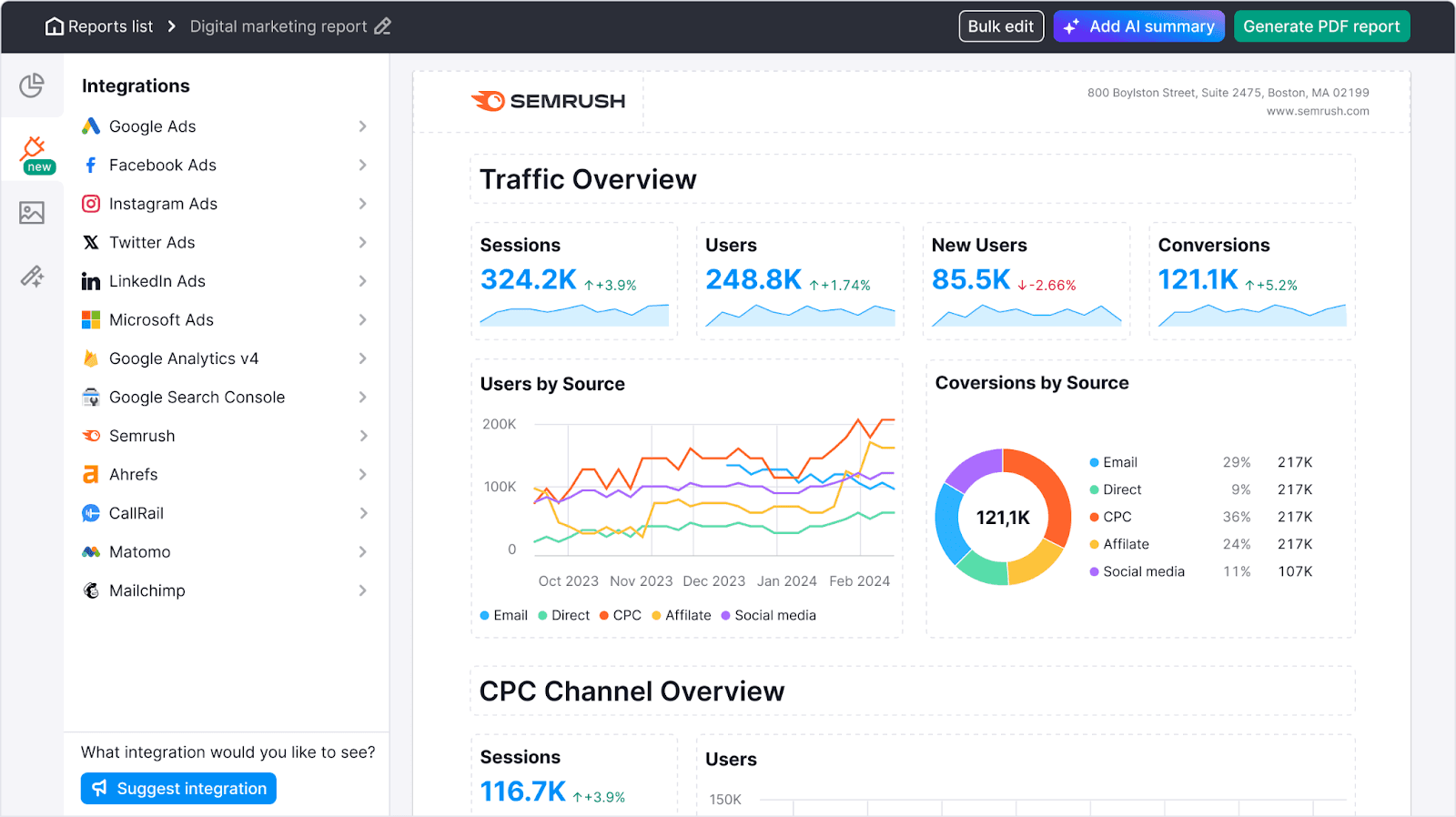
Semrush is a comprehensive digital marketing platform that combines SEO, PPC, content marketing, and competitive research with AI-driven insights. Its key strengths lie in content optimization and competitive intelligence, making it a strong choice for teams that need to manage visibility across both traditional search and AI answer engines.
What we found most valuable
Content optimization tools: Offers AI-assisted content analysis, topic suggestions, and keyword insights to improve visibility in search engines.
Competitive intelligence: Tracks competitor strategies including keywords, backlinks, and content performance.
Multi-channel insights: Covers SEO, paid search, and content marketing, providing a holistic view of digital presence.
Best for
Marketing teams looking for an all-in-one SEO and AI insights platform.
Businesses seeking to optimize content while monitoring competitors.
Agencies managing multiple client campaigns across search and content channels.
Pros
Combines traditional SEO metrics with AI-driven insights.
Supports competitor benchmarking and content gap analysis.
Multi-channel data provides a complete digital marketing perspective.
Cons
Not focused exclusively on AI visibility or LLM tracking.
Can be overwhelming for small teams due to the sheer range of features.
Some advanced features require higher-tier subscriptions.
Pricing
Starter: $199/mo (50 prompts, 500 keywords, daily tracking, 5 websites).
Pro+: $299/mo (100 prompts, 1500 keywords, 15 websites).
Advanced: $549/mo (200 prompts, 5000 keywords, 40 websites, API integration, MCP access).
6. SE Visible
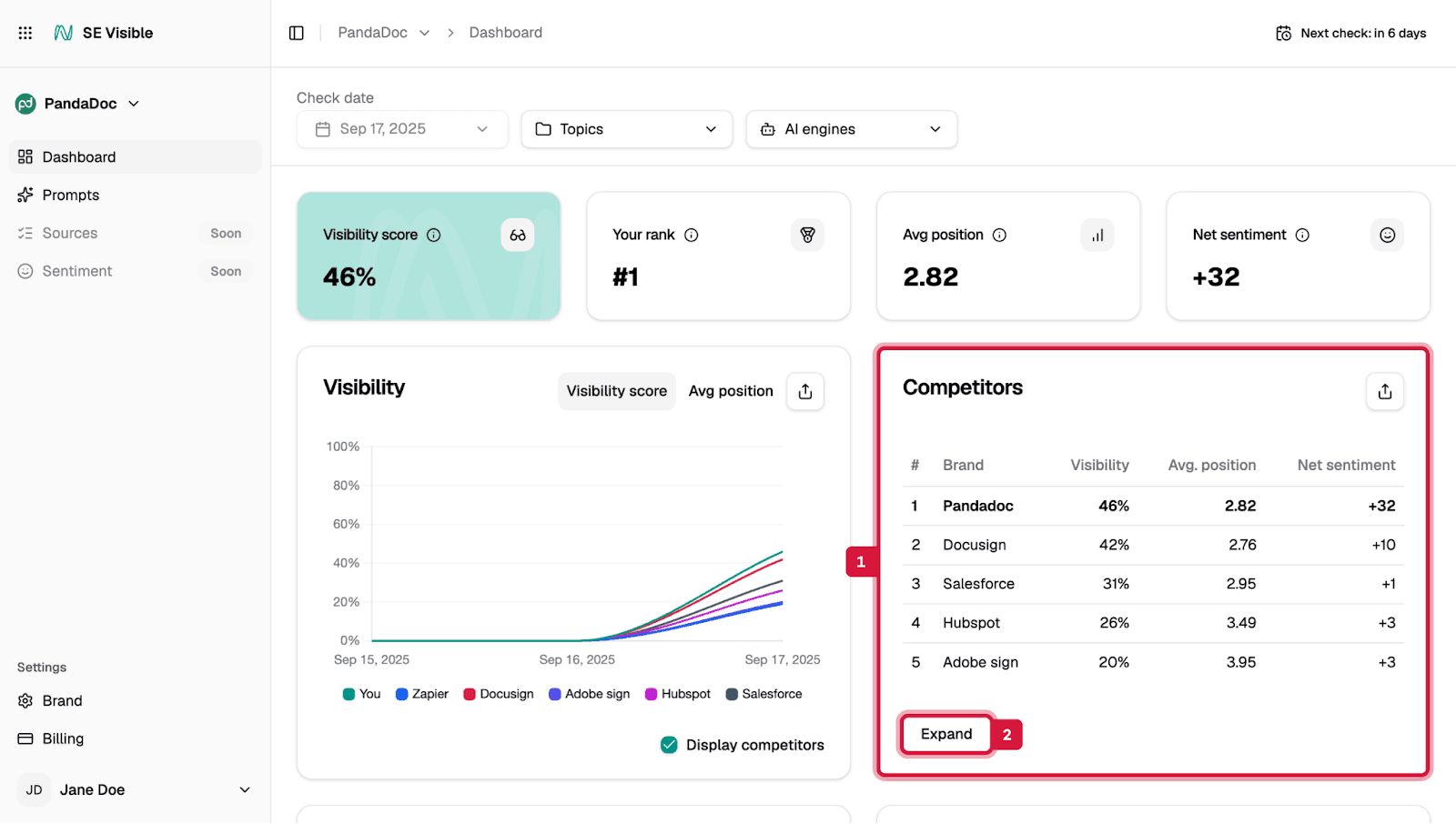
SE Visible is an AI visibility platform built on SE Ranking's 13+ years of data experience. It provides a clear view of how a brand appears across AI search systems such as ChatGPT, Perplexity, AI Mode, and Gemini. The platform tracks brand rankings, mention frequency compared to competitors, and the sentiment of those mentions, with ready-made metrics and straightforward visualisations designed for teams that need clarity without complexity.
What we found most valuable
Multi-platform visibility tracking: View how often your brand appears across ChatGPT, Perplexity, AI Mode, and Gemini in a single dashboard, with average position and overall visibility metrics.
Competitor benchmarking: See which competitors appear alongside your brand, their positions, and how they are being represented.
Sentiment analysis: Track whether AI-generated mentions are positive, negative, or neutral, with weekly updates to monitor changes over time.
Filterable dashboard: Apply filters for date, region, topic, competitors, sentiment, and AI engine for a tailored view of performance.
Best for
CMOs, agency owners, and marketing leaders.
Brand marketers seeking a clear view of AI-driven brand visibility and competitive positioning.
Pros
Tracks real AI-generated answers rather than simulations.
Intuitive dashboards and straightforward onboarding.
Reliable data quality backed by SE Ranking's experience.
Sentiment tracking to monitor potential reputation issues.
Cons
Limited sharing options, with only CSV export currently available.
Pricing
Core: $189/mo (450 prompts, 5 brands).
Plus: $355/mo (1000 prompts, 10 brands).
Max: $519/mo (1500 prompts, 15 brands).
7. Scrunch AI
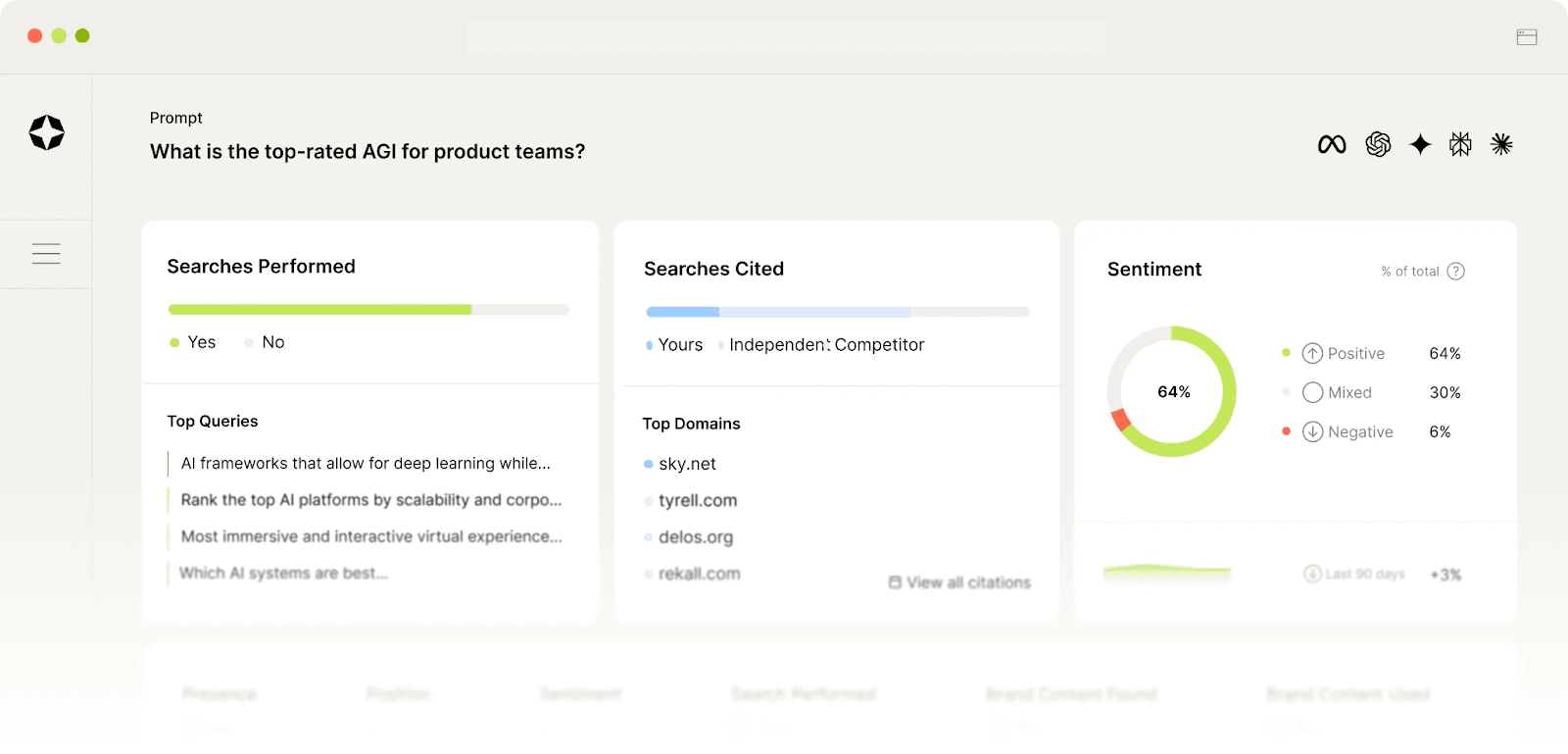
Scrunch is an AI search visibility and optimization platform that monitors prompts across multiple AI engines. Its main strength lies in detailed analysis, particularly around segmentation architecture, parameter definition, and intuitive filtering. Users can assign buyer personas or themes to each prompt and track sentiment and share-of-voice across all engines.
What we found most valuable
Broad engine coverage: Monitors ChatGPT, Claude, Perplexity, Gemini, Google AI Overviews/Mode, and Meta AI.
Prompt-level tracking: Allows management of prompts by persona, location, sales funnel stage, and more.
Sentiment and share-of-voice analysis: Reports whether AI presents your brand positively or negatively and benchmarks performance against competitors.
AI site audit: Highlights technical issues such as broken links or indexing blockers that may impact AI visibility.
Best for
Enterprises requiring SOC2 compliance, role-based access, and API integration for data workflows.
In-house SEO or content teams that need deep, granular AI visibility data.
Agencies and large organisations managing multiple brands and campaigns.
Pros
Provides comprehensive visibility data across all major AI engines.
Granular control over which queries to track.
Real-time feed of AI bot visits with GA4 integration.
Cons
Focused primarily on monitoring rather than content optimization.
Does not include schema or SEO editing tools.
Feature-rich interface that can be complex for new users.
Pricing
Core: $250/mo (125 custom prompts, 5 users, 5 page audits, 1 brand workspace).
Enterprise: Custom pricing.
7-day free trial available.
8. Otterly AI
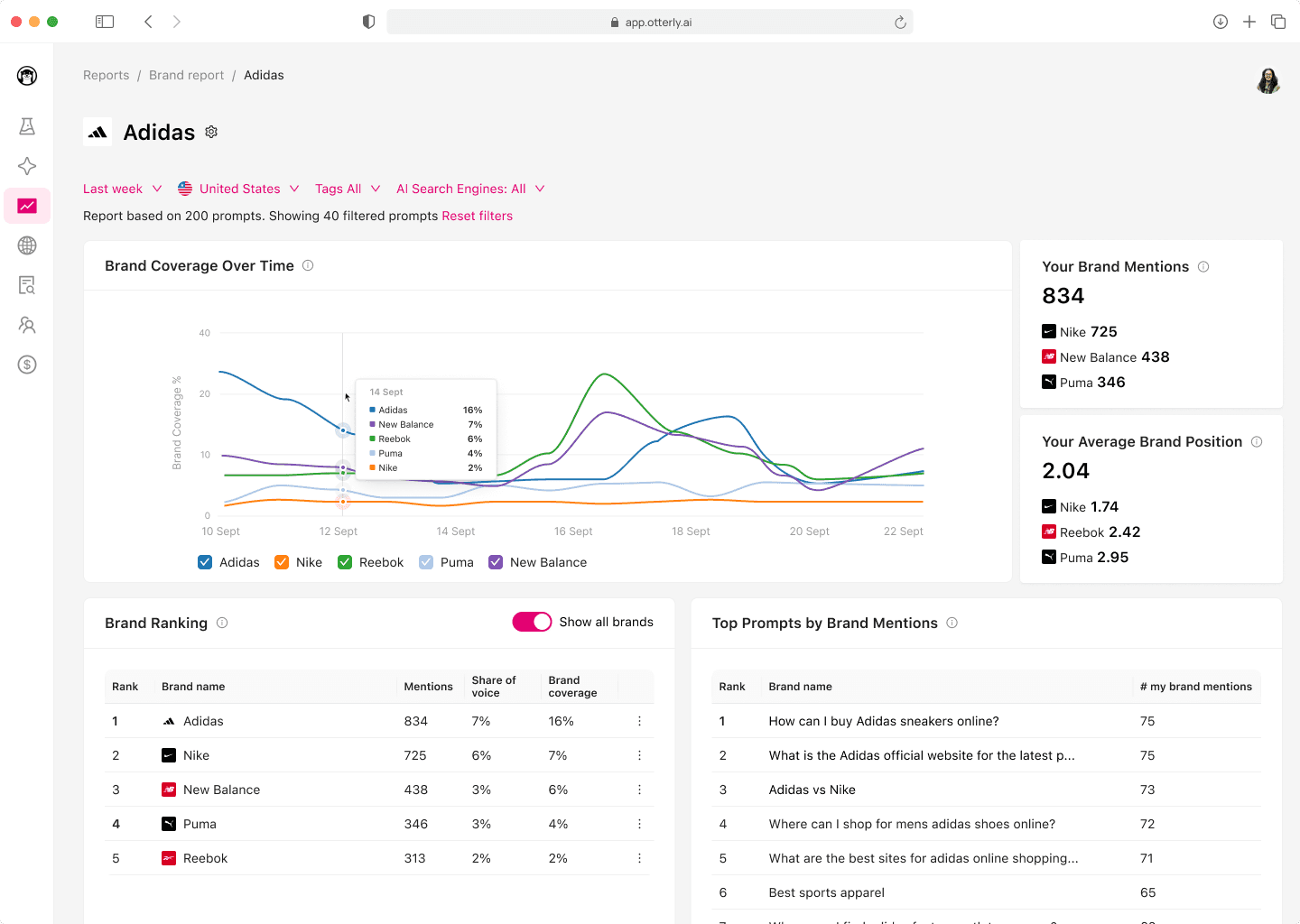
Otterly AI is a location-focused AI visibility tool designed to provide detailed audits. Users value it as a practical monitoring and early-warning solution rather than a full-scale analytics platform. Where it stands out is in the depth of its GEO auditing, evaluating over 25 technical and content factors per location and surfacing prioritized recommendations.
What we found most valuable
Comprehensive coverage: Tracks six AI search platforms including ChatGPT, Google Overviews/Mode, Perplexity, Copilot, and Gemini, with daily updates.
Brand Visibility Index: Provides a normalized visibility score for each brand, allowing easy ranking within an industry.
Deep GEO audit: Evaluates multilingual content, schema usage, and page structure across 25+ technical and content factors, with prioritized recommendations.
Best for
Agencies or brands with a global or local SEO focus requiring location-specific AI audits.
Teams that rely on automated insights and actionable recommendations rather than raw data.
Pros
Audit reports provide clear, actionable next steps such as adding schema, improving content length, or fixing crawl issues.
No limits on team members or the number of brand reports.
AI-powered keyword research tool to identify the most relevant prompts for each target region.
Cons
Does not provide AI-driven traffic estimates.
Data updates are weekly rather than in real time.
The interface contains many tables and data points, which can be overwhelming for new users.
Pricing
Lite: $29/mo (15 prompts, daily tracking, domain ranking).
Standard: $189/mo (100 prompts, daily tracking, detailed reports and exports).
Premium: $489/mo (400 prompts, daily tracking, unlimited brand reports, team members, workspaces).
Enterprise: Custom pricing.
The future of AI visibility: what to expect in 2026 and beyond
Search is increasingly behaving like a conversation. Users ask questions directly to AI systems and receive synthesized answers, often without clicking through to a single webpage. Traditional click-based ranking is becoming less central. Being cited as a source in an AI-generated response is carrying more weight, and that shift is accelerating.
Search will also move beyond plain text. Voice assistants, visual search, and chat-based interfaces are growing in importance. Google's AI Mode, which integrates voice, vision, and text, is an early example of what this looks like at scale. SEO strategies will need to adapt to these new interfaces, making AI visibility tracking tools more important, not less.
Industry research from Bain and McKinsey indicates that generative search is already the preferred choice for many users across the full purchasing journey. By 2027 to 2028, AI-driven searches are projected to influence billions of dollars in commerce. Content will need to be structured and authoritative not just for human readers but for AI systems. Machine-readability is becoming as important as traditional SEO.
AI models rely on knowledge graphs and the credibility of sources when generating answers. By 2027, having a clear entity structure and implementing schema markup will be baseline requirements. Incorporating E-E-A-T elements, specifically expertise, experience, authority, and trust, is a smart strategy for any brand that wants to be consistently referenced as a reliable source.
Conclusion
AI-generated answers have become one of the fastest and most convenient ways for people to access information. If your brand is not appearing in LLM responses, you risk losing audience attention before traditional search results are even seen.
There is no single best AI visibility tool. Effective visibility in AI search is built by using the right combination of platforms, each offering a different layer of insight. KIME provides end-to-end AI visibility tracking and GEO benchmarking and actions to act on to improve visibility. SE Visible delivers full-spectrum competitive tracking. Ahrefs Brand Radar offers citation and share-of-voice analysis at scale. Profound focuses on branded answer detection for enterprise. Tools like Peec AI and Otterly AI are well suited to quick checkups and location-specific audits.
If you are new to AI visibility tracking, starting with a free plan or trial is the right move. Even a single scan can reveal whether AI systems recognize your brand and surface the areas with the most room for improvement.
FAQ
Q1. What is AI visibility?
AI visibility refers to how frequently your brand or content appears in AI-generated answer engines such as ChatGPT, Perplexity, Claude, or Google's AI Overviews. It is distinct from traditional SEO ranking because it measures citation presence within AI-synthesized responses, not just webpage rankings.
Q2. Why do websites lose visibility in AI answers?
Websites lose AI visibility when their content is not authoritative, well-structured, or up to date. LLMs tend to reference sources that are clearer, more accurate, and better cited. Thin content, poor schema implementation, and lack of E-E-A-T signals all contribute to being overlooked.
Q3. Can AI visibility improve SEO?
Indirectly, yes. Content that performs well in AI search tends to be authoritative, structured, and high-quality, all of which are factors that support organic SEO. AI visibility tools help identify strategies that strengthen both AI presence and overall search performance simultaneously.
Q.4 Which AI visibility tool is best for agencies?
KIME and Peec AI are both strong choices for agencies. KIME offers multi-seat access, client view-only access, competitive benchmarking, and content optimization (action center) in a single platform. Peec AI's unlimited user model on the Starter plan is well suited to distributed teams managing multiple client accounts.
Q5. How quickly can I expect to see results from AI visibility improvements?
Most brands see measurable changes in LLM citation frequency within 30 to 45 days of implementing GEO strategies. The timeline depends on the LLM platforms being tracked, the authority of the domain, and the quality of content changes made. Tracking with a tool like KIME allows you to measure progress with precision rather than guessing.
Vasilij Brandt
Founder of KIME
Del